Goethe Exam B2- reading comprehension
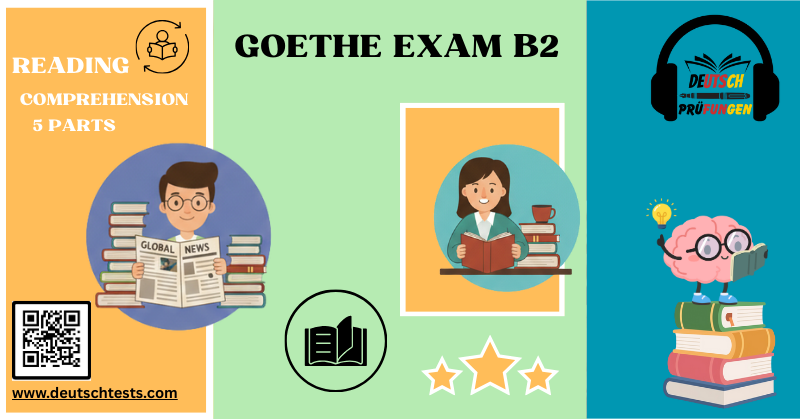
Goethe Exam B2 reading comprehension consists of 5 different parts, which you have 65 minutes to complete.Part 1
In this part of the Goethe exam B2, 4 different people take a position on a topic. Each person expresses their opinion in approximately 150 words. These people are faced with 9 different statements that must be assigned to them. The easy thing about this part is that all statements can be assigned. Therefore, no statement is marked with a 0 or x, meaning no statement is left unused. The statements refer to specific ideas in the statements. The difficult thing is that the people take a position on the same topic. For this reason, it is absolutely not enough to simply recognize the topic; you must read in depth and identify the core ideas of each opinion. Synonyms play a crucial role in matching the statements to the people.Technique
1. Always start with the statements! Read them through and highlight keywords in different colors. 2. Then read the statements and try to find the appropriate statement based on the keywords. In our web portal, the statements are on the right, and the statements are on the left. Next to each statement, there is a drop-down list with the names of the people.Part 2
This part consists of a text of approximately 350 words to a maximum of 370. In this text, you have to integrate 8 different sentences into 6 gaps. This means that two sentences are left unused. This is the difficult part.Technique
1. Read the sentences or complements and highlight the keywords and key sentence connectors. Method 1: Guess the possible sentence from the context. Method 2: If you are not 100% sure using Method 1, you have to rely on the sentence structure and ask yourself what sentence structure is suitable for the gap. Is a main or subordinate clause appropriate? If a subordinate clause is necessary, you also need to know what kind of subordinate clause or sentence connector would meaningfully fill the gap. It is crucial that you do not lose track of the text. If this happens, this part will take more time, and your chances of success will be shaky. At www.deutschtests.com ,you select the appropriate sentence for each gap from a drop-down list of all possible sentences.Part 3
This is a classic task with a text of approximately 370 words and 6 multiple-choice questions. This part is similar to Parts 2 and 3 in B1 Goethe test and Telc test B1 Part 2, differing only in its length and complexity. This part of the Goethe B2 exam is very similar to Telc exam B2 Part 2, and we therefore recommend using the same technique.Technique
For such a long text and at such a high level, we suggest the following technique: 1. Read the questions and the possible answers! Highlight the keywords in them! 2. If a word seems unfamiliar to you, always ask yourself, “Is this word crucial to the answer?” 3. Through all the questions and possible answers, you will sometimes recognize a guide that gives you clues about the text. 4. Once you have completed the previous steps, start with the text. 5. Quickly skim the text! to identify the main theme, core ideas, and structure of the text. In this step, you will know which section answers which question. The fact that you may not be able to answer some questions depends on your actual level. 6. During the second reading, “thorough reading,” you must be able to answer all the questions. Use this approach several times to speed up the process.Part 4
Seven people express themselves on a specific topic in a short text (50 words). These people have six possible headings, meaning there is no suitable heading for one statement. This part is similar to Part 1, but the texts are somewhat shorter and the headings are more comprehensive. This means that the headings encompass an entire utterance. You can use the same technique in Part 1. In our web portal, all statements are on the left, while the possible headings are on the right, with a drop-down list of possible people.Part 5
This part is about an order or statute, or something similar, where you must integrate three suitable subheadings into the text from seven possible ones. In our web portal, you select the appropriate subheading from a drop-down list. This part builds on Part 6 of B1 Goethe test with one difference. The text in Goethe exam B2 Part 5 and B1 Part 6 is similar, except that in B1 Goethe test you must answer three multiple-choice questions. In this part, you must assign three of the seven headings.Summary
1. Reading comprehension in the Goethe B2 exam is quite long and requires concentration. This requires exercises and targeted preparation, which you can only find on our web portal. These will give you an insight into the difficulty of this level. 2. The exam is based on some parts of B1 Goethe test. If you have previously prepared for B1 and taken the B1 test, you will find it easier to pass B2 than someone who has never dealt with B1, not only because some parts will seem familiar to you, but because you are accustomed to a long and sometimes complex exam. 3. Vocabulary, especially synonyms, plays a key role in the Goethe B2 exam. For this reason, we recommend that all German learners at this level use a German-German dictionary, as this is the only way to guarantee vocabulary appropriate for B1. 4. Reading skills at Goethe exam B2 level can only be strengthened in addition to the course through non-course-related reading. This means reading outside of the course, especially the press. Pay attention to news in the press and people’s views on these topics. You have to familiarize yourself with current issues in Germany and Austria! 5. Passing the Goethe exam B2 and obtaining the Goethe B2 certificate is the result of extensive preparation, both alongside and after the German course.Here are links to free German model tests:
free model tests A1 Goethe │ free model tests A1 Telc
free model tests A2 Goethe │ free model tests A2 Telc