
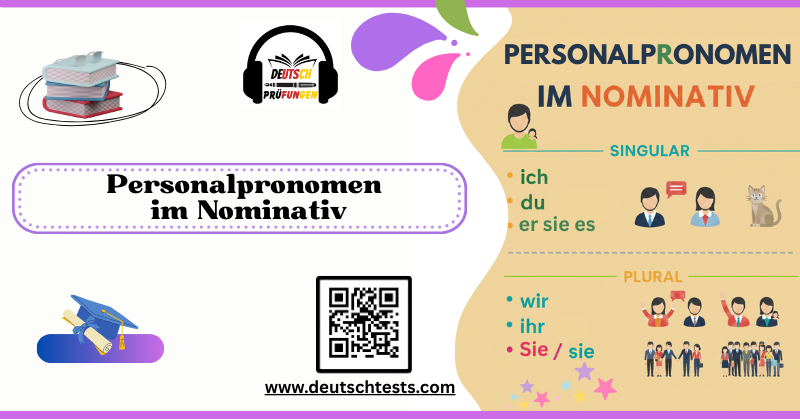
Personal pronouns nominative
Personal pronouns in the nominative case refer to people as well as things. The following table explains them in several languages:| German | English | Arabic | Spanish | French | Russian | |
| 1st person singular | I | I | انا | yo | each | y |
| 2nd person singular | you | you | انت | tú | do | tyu |
| 3rd person singular | he | he | هو | él | il | on |
| she | she | هي | ella | elle | ona | |
| it | it | ono | ||||
| 1st person plural | we | you | نحن | Nosotros nosotras | nous | мы |
| 2nd person plural | her | you | انتم | Vosotros vosotras | vous | y |
| 3rd person plural | She | you | انتم | usted | vous | Вы |
| she | They | هم | Ellos / ellas | Ils / elles | oni |
What is the function of personal pronouns?
Personal pronouns in the nominative case determine verb conjugation. That is, they decide how the verb appears in the sentence.- Karmen is athletic. She plays football.
- Do you play football?
- You play football professionally.
- We only play football on weekends.
- Maria likes the table. But it’s expensive.
- The bag is beautiful. It’s made of leather.
- The window is clear. It’s new.
- The dictionaries are on the shelf. They are valuable.
What is the relationship between personal pronouns and possessive articles?
Personal pronouns also determine the possessive article.- Hans is intelligent and hardworking. His wife and children are also intelligent and active.
- We play guitar. Our band is performing in Cologne this weekend.
Exercises in personal pronouns in the nominative case
1. Which personal pronoun fits? Sometimes several pronouns are possible.- ……………. eat dinner with my parents.
- Maria goes to the cafe in the evening. ……………. has the day off today.
- ……………. cook pasta for lunch.
- Is ……………. preparing lunch?
- How often do you drink ……………. per day?
- Do you know Tobias? He’s helping with the project.
- I shop at the shopping center around 10 pm.
- Do you play an instrument? Yes, I play the piano.
- My grandparents are retired and have a lot of time on their hands. ……………. work in the garden.
- Julia still writes letters. ……………. doesn’t have an email address.
- This is a table. ……………. is expensive.
- My car is broken down. ………. is in the garage.
- This is a lamp. ……………. is inexpensive.
- We miss the dictionary. ……………. is valuable.
- This is a radio. ……………. is important.
- My mother likes to buy expensive mugs. ……………. but they look colorful.
- These are tables. ……………. are made of wood.
- Our apartment is old. ……………. is expensive.
- These books belong to Luis. He likes to read.
- We have orange trees in the garden. They look beautiful.
Kostenlose A1 Prüfung Goethe Modelltests │ Kostenlose A1 Prüfung Telc Modelltests
Kostenlose A2 Prüfung Goethe Modelltests │ Kostenlose A2 Prüfung Telc Modelltests
Kostenlose B1 Prüfung Goethe Modelltests │ Kostenlose B1 Prüfung Telc Modelltests
Kostenlose B2 Prüfung Goethe Modelltests │ Kostenlose B2 Prüfung Telc Modelltests